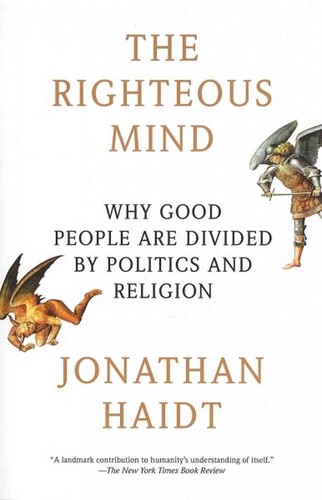
The Righteous Mind
Jonathan Haidt
Explore the evolutionary "moral taste buds" that shape our political and religious identities, revealing why our gut instincts often override our logic. By mastering these hidden psychological foundations, you will gain the rare ability to understand opposing viewpoints and foster genuine connection in an increasingly polarized world.
Beyond Rationalism
Explores the origins of morality, challenging the idea that moral reasoning is a purely logical process and introducing the primacy of intuition.
The Rationalist Delusion
The Moral Dumbfounding Effect
The Elephant and the Rider
Introduces the central metaphor for how the mind works: the intuitive 'Elephant' and the reasoning 'Rider'.
Meet the Elephant and the Rider
The Social Intuitionist Model
The Strategic Lawyer
Examines why our reasoning minds act more like a press secretary or a lawyer than a neutral scientist.
Reasoning as Public Relations
The Glauconian Challenge
Breaking the WEIRD Bubble
Criticizes the narrow focus of Western moral psychology and introduces cultural variations in morality.
The WEIRD Perspective
The Three Ethics
The Five Taste Buds of Morality
Introduces Moral Foundations Theory, comparing our moral sense to a palate with diverse receptors.
Evolution of Moral Tastes
Defining the Foundations
Expanding the Moral Palate
Deepens the analysis of the remaining moral foundations that bind groups together.
Loyalty and Authority
Sanctity and the Sacred
The Conservative Advantage
Explains the difference between liberal and conservative moral matrices and why one side has a broader reach.
The Liberty Foundation
The Moral Advantage
The Moral Matrix
Synthesizes how moral foundations create 'matrices' of reality that blind us to the logic of our opponents.
Mapping Political Ideologies
The Groupish Animal
Argues that humans are '90% chimp and 10% bee,' highlighting our evolved capacity for groupishness.
Multi-Level Selection
Shared Intentionality
Turning on the Hive Switch
Describes the psychological mechanism that allows individuals to lose themselves in a larger whole.
The Self-Transcendence Experience
Mechanisms of Hive-ification
The Purpose of Religion
Re-evaluates religion not as a set of false beliefs, but as a crucial technology for social bonding.
Religion as Adaptation
Belonging over Believing
Bridging the Divide
Offers a path forward for political and social reconciliation through mutual understanding of moral foundations.
The Roots of Left and Right
Cultivating Moral Humility
Start reading with AI
Interactive Socratic dialogue, level by level